The Foundation
The Permission Problem
Most of us tell ourselves it’s a clarity problem. We don’t know enough yet. We need to do more research, think it through more carefully, wait until the idea is more formed.
And sometimes that’s true. But more often, underneath the not knowing, there is something personal and harder to name: we don’t yet believe we’re allowed to find out.
We are not allowed to:
Want something of our own.
Try before we are certain.
Build something imperfectly and visibly, on the side of everything else we carry.
Clarity and permission are rarely separate problems. The woman who says she needs more clarity is often using the gap as a reason to wait. And the waiting feels responsible, sensible, safe. It looks like preparation. But it can become another place to hide.
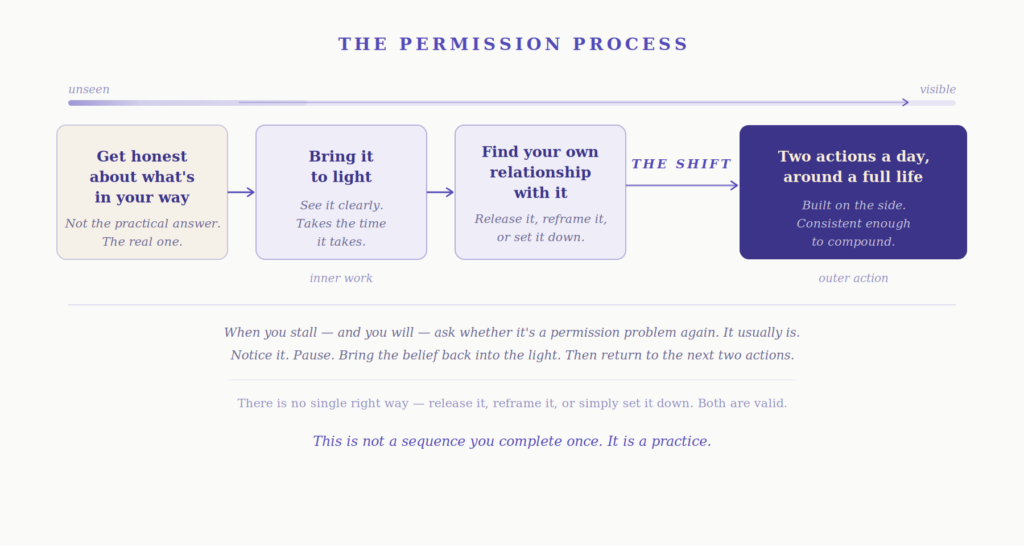
The work starts by asking an honest question: what is actually in your way?
Take a moment with that.
Not the practical answer. The real one.
If the honest answer has anything to do with what we deserve, what we’re ready for, or what other people will think; that is a permission problem. If it comes down to whether someone like us gets to do something like this; that is a permission problem. And more research won’t touch it.
The work starts by bringing the belief into the light. Gently. Honestly. Without making ourselves wrong for having it.
Maybe the belief once protected us. Maybe it helped us stay safe, responsible, acceptable or useful. Maybe it formed for good reasons, even if it no longer fits who we are now.
Or maybe it was simply never ours to carry in the first place.
Either way, once we can see it clearly, we get to decide what happens next. That moment – seeing it for what it is – is where permission begins.
Permission becomes real when it changes what we do.
The Permission Process
That does not mean making one huge leap, blowing up our life or pretending we suddenly feel fearless. It means taking small, steady actions that create proof.
Two actions a day.
Small enough to fit inside a full life. Consistent enough to build momentum. Honest enough to show us what is possible.
Each action makes a little more of our capacity visible. That capacity was already there. We just needed evidence we could trust ourselves.
And when we stall, because we will, the question is worth asking again: is this a practical problem, or is there another layer of permission underneath it?
Sometimes the next step feels hard because we need a better plan. Sometimes it feels hard because being seen, choosing ourselves, or asking for what we want has touched an old belief.
That is not failure. That is the process deepening.
Notice it. Pause. Bring the belief back into the light. Then return to the next two actions.
This is not a sequence we complete once. It is a practice. And for many of us, it is the practice that moves us from private wanting into visible action.
Ready to take the first step?
The free checklist takes five minutes and will tell you something honest about where you actually are. The Validator goes deeper, and gives you a personalised picture of your readiness and exactly what to do first.